Bathroom remodeling where the waterproofing is the product.
Three clear tiers — Refresh $8k–$13k, Full Build $15k–$22k, Spa Build $22k–$26k. What separates a bathroom that lasts twenty years from one that fails in five is entirely behind the tile: a real waterproofing membrane, a correctly sloped pan, and a fan that actually moves air outside.
Why do bathrooms fail, and what stops it?
Because water gets behind the tile, and in most bathrooms nothing is there to stop it. Cement backer board is not waterproofing — it is a stable substrate that water passes straight through. A bathroom that lasts needs a genuine waterproofing layer: a bonded sheet membrane like Schluter Kerdi, a foam board system like Wedi, or a properly applied liquid membrane, installed over the pan and every wet wall with the seams banded and the corners detailed. The second failure point is ventilation. A fan that is undersized, or ducted into the attic instead of through the roof or wall, moves your shower’s moisture into your insulation — which is how you get mould in the ceiling of the room below.
Three bathroom tiers.
Ranges for a typical room at mid-grade materials. The calculator scales them to your actual square footage and conditions.
Same footprint, all-new surfaces and fixtures. The right scope for a hall or guest bath that is dated but structurally sound.
- New vanity, top, sink, and faucet
- New toilet and trim
- Tile floor and tub or shower surround
- Mirror, lighting, exhaust fan, accessories
- Paint and trim
Down to the studs. New waterproofing, new plumbing and electrical in the room, and a proper tiled shower — the tier where the work behind the wall actually gets fixed.
- Full demolition to the studs
- Sheet or liquid waterproofing membrane at the pan and all wet walls
- Tiled shower with niche and bench as designed
- Frameless or semi-frameless glass
- New plumbing rough-in and valve bodies in the room
- Humidity-sensing exhaust fan ducted to the exterior
- Vanity, tops, mirrors, lighting, and full trim
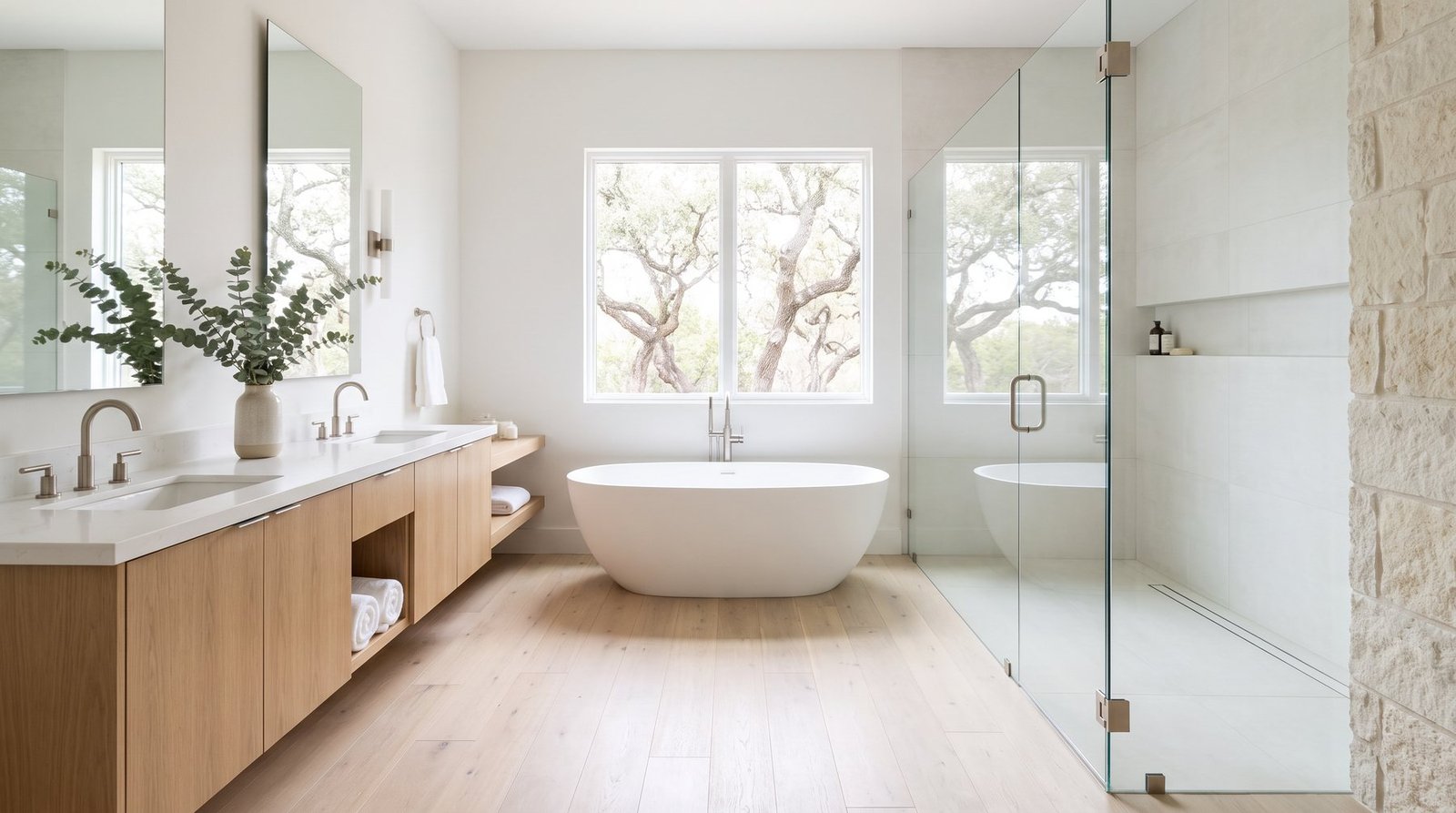
A designed primary bath: curbless wet room, large-format or stone tile, freestanding tub, dual vanity, and heated floor as an option.
- Curbless or low-profile wet room with linear drain
- Large-format porcelain or natural stone, floor to ceiling
- Thermostatic valves, rain head, handheld, optional body sprays
- Freestanding soaking tub with floor-mounted filler
- Custom double vanity, stone tops, backlit or framed mirrors
- Electric radiant heated floor (option)
- Full frameless glass, curbless entry detailing
What a real waterproofing assembly looks like
On a Full Build or Spa Build we take the shower to the studs and build the assembly properly: a pre-sloped or mud-set pan at a correct quarter-inch-per-foot fall to a bonding-flange drain, membrane over the pan and up every wet wall, seams banded, inside and outside corners detailed with preformed pieces, and the niche and bench waterproofed as part of the same continuous layer rather than patched in afterwards.
Then it gets flood tested before a single tile goes on. That test is the only way to know the assembly works, it takes 24 hours, and it is the step most commonly skipped. We do it, and you are welcome to look at it.
Hard water decides your glass, your valves, and your stone
The most common regret we see in a Hill Country bathroom is a beautiful frameless glass enclosure that is permanently etched two years in, next to a shower valve that no longer holds temperature. Both are hard-water outcomes and both were preventable at rough-in for a fraction of the repair cost.
At 15 to 25 grains per gallon, we plan the softener loop and drain before plumbing rough-in, specify scale-tolerant pressure-balance or thermostatic valve bodies, and select glass coatings and stone finishes that tolerate mineral contact. Honed and matte surfaces hide spotting; polished marble in a hard-water shower is a maintenance commitment you should make knowingly.
Ventilation, sized and ducted correctly
We size the fan to the room rather than to whatever fits the existing hole, use a humidity-sensing model so it keeps running after you leave, and duct it to the exterior with insulated duct and a proper terminating cap. Never into the attic, never into a soffit that dumps back under the eave.
On a Spa Build with a steam shower or a fully enclosed wet room, the ventilation and the vapour sealing are engineered together — a steam shower in a room built like an ordinary bathroom will find the weakest point in your assembly and fail there.
Wells, flow, and fixtures you can actually run
Municipal water gives you effectively unlimited simultaneous flow. A well does not. Before we finalize a fixture package on a Bulverde or Spring Branch property we measure delivered flow and pressure, then size to it.
A rain head plus body sprays plus a filling tub can exceed what your pump and pressure tank supply, and the failure is not dramatic — it is a shower that goes cold when the dishwasher runs. Either the fixture package fits your system, or the proposal includes the pump, tank, or storage work that makes it fit. We will not sell you a shower your well cannot run.
What is in scope, in writing.
This is the level of detail our bids carry. If another bid does not name these things, you are comparing two different projects.
Where corners normally get cut.
Straight answers.
What is the difference between the Refresh and Full Build tiers?
Do I really need a waterproofing membrane?
Can you build a curbless shower in an existing house?
Do I need a water softener for a new bathroom?
How long will the bathroom be out of use?
Can you match tile in an older Universal City or Schertz home?
Is a steam shower worth it?
Your bathroom price, fixed, in 24 hours.
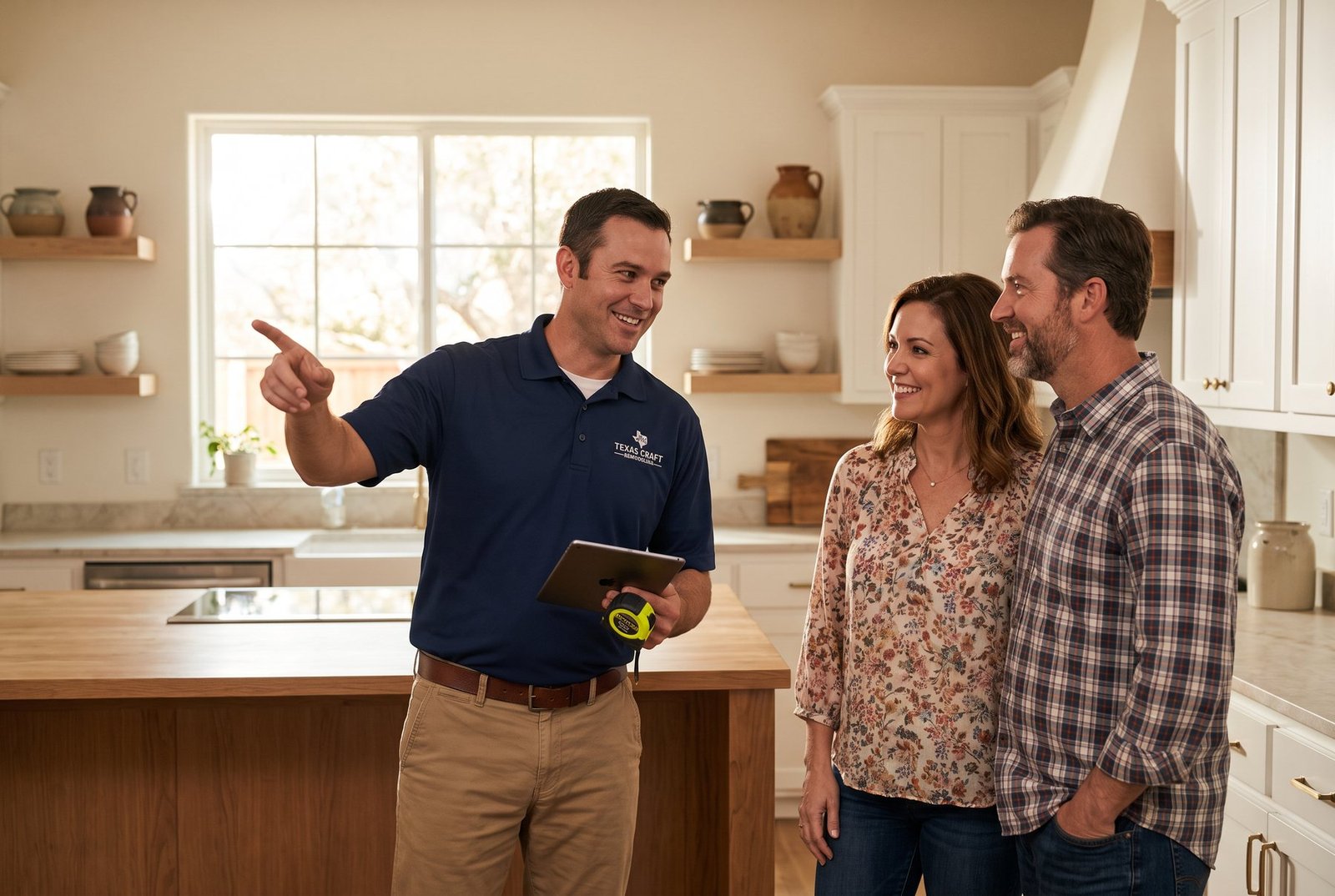
A 30-minute walkthrough with the project owner, then a written fixed price within a day. No commission salespeople and no obligation.
Request a bathroom bid
Find out what your bathroom actually costs.
Book the 30-minute walkthrough. Written fixed price within 24 hours.